
Modular vs Traditional Build
We manage both. That makes us the wrong people to hype either — and the right people to tell you which one fits your site, your budget and your deadline.
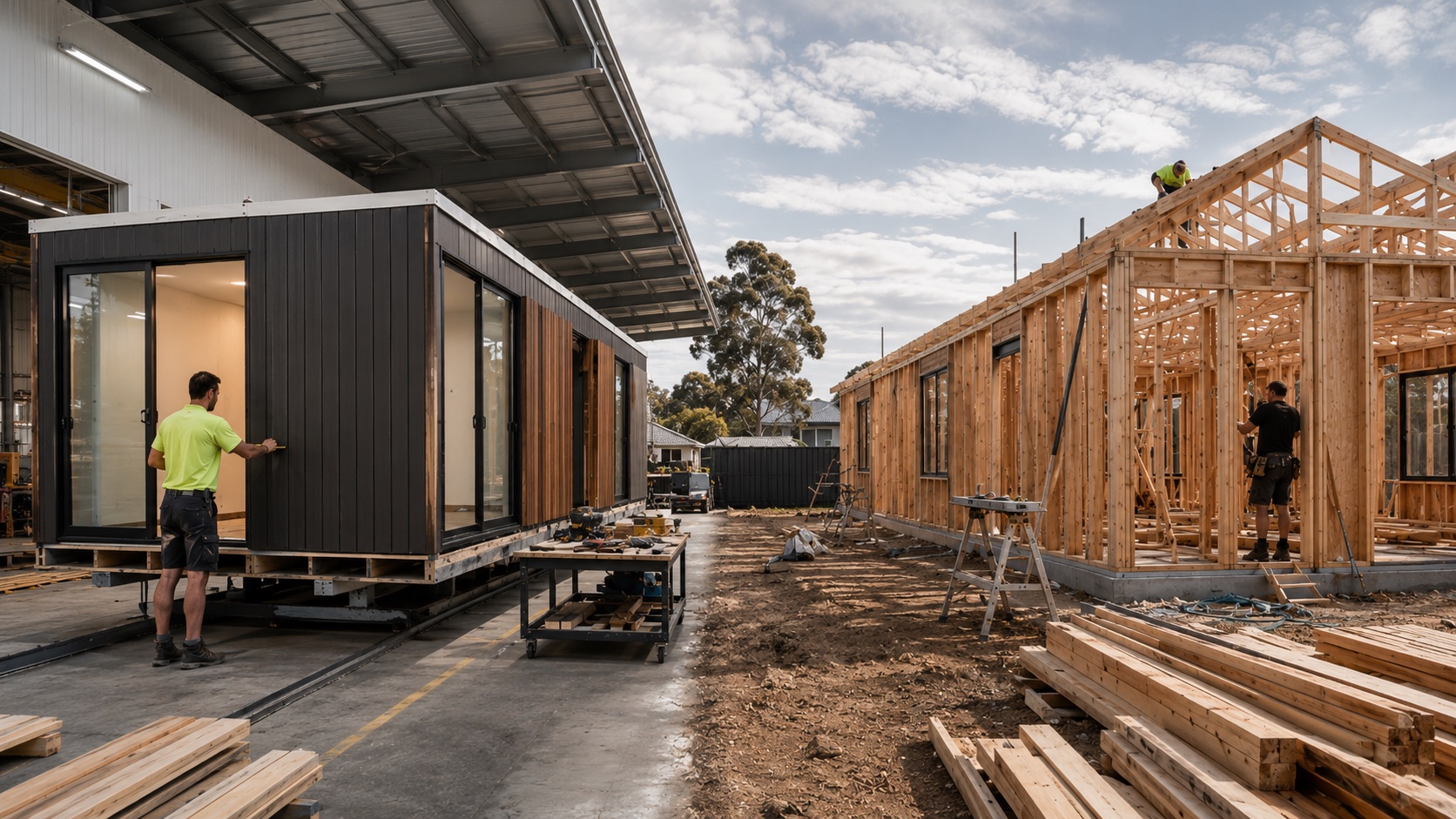
Seven Factors, Side by Side
| Performance Metric | Modular Construction | Traditional Build |
|---|---|---|
| Build time | Factory production and site works may overlap; approvals, design release, logistics and factory capacity still govern the programme. | More trades proceed sequentially on site; design, approvals, weather and trade availability govern the programme. |
| Cost certainty | Factory scope may be priced earlier, but transport, crane, site works, connections and exclusions must be reconciled. | Cost certainty depends on design completion, procurement, site conditions, prime-cost items and variation controls. |
| Weather & site risk | Factory scope is sheltered; foundations, services, transport and installation remain exposed to site and weather conditions. | A larger share occurs on site, so weather allowances and sequencing need explicit management. |
| Quality control | Factory QA can be staged and repeatable; the inspection plan and site installation checks still matter. | Quality depends on documentation, trade capability, supervision, hold points and defect close-out. |
| Design flexibility | Module dimensions and transport limits constrain architectural forms. | Often accommodates different forms, but remains constrained by the site, planning rules, structure and budget. |
| Finance complexity | Off-site work may require lender-specific confirmation on contracts, valuation, security, insurance and payment timing. | A more familiar lending pathway, but still subject to project valuation, borrower assessment and lender conditions. |
| Best suited for | May suit repeatable designs and sites with workable transport, crane access and coordinated parallel activities. | May suit highly bespoke forms or sites where module transport and crane access are impractical. |
Where the Money Actually Goes
A modular budget places more cost in the factory contract and in interfaces such as transport, craneage, installation and site preparation. Whether total cost is lower depends on like-for-like scope, design maturity, the site, logistics, finance and risk allowances.
The question is not simply "is modular cheaper?" It is "does modular make sense for this block?" — and that is a feasibility question, not an opinion.
Illustrative shape, not dollar values — every site differs. Run the calculator for yours.
Get the Answer for Your Site — Both Tracks, One Report.
Our Two-Track Feasibility runs your block through both scenarios: modular and traditional, with costs, timelines, finance implications and risk flags side by side. One document. One clear recommendation.
Want a rough number before you talk to anyone? Our free modular vs traditional cost calculator compares the budgets and programmes you enter and shows an indicative holding-interest difference. It does not supply a market estimate or replace a feasibility study.
Two-Track Feasibility Includes:
- ✓ Modular transport clearance assessment
- ✓ Indicative crane and installation scope with stated assumptions
- ✓ Cash-flow scenarios comparing holding-cost exposure
- ✓ Specific zoning constraints for both methods
Two ways to build. Test the trade-offs for your block.
Do not choose a delivery method from a generic percentage. Compare scope, programme, finance, logistics and risk on the same assumptions.